BW Offshore has a well-developed corporate governance structure, and adheres to the Norwegian Corporate Governance Board (NUES) Code of Practice, last updated on 14 October 2021.
About FPSOs
Learn more about the FPSO (Floating Production Storage and Offloading) by exploring the unit below.
7
E-House
The E-House (Electrical House) serves to distribute power from the power generation to all personnel onboard the FPSO. The E-House contains electrical switchboards and distribution boards necessary to distribute the electrical power.
In addition, the E-House room also contains some control panels to control parts of the topside or subsea facilities.
8
Accomodation
Similar with services of an onshore hotel, the accommodation is first and foremost the safe-haven for the FPSO’s personnel, where they can recharge their batteries after a long day’s work.
In addition, the operations of the asset is run from the Central Control Room, with its adjoining administrational and conference areas. A multitude of decks offer a wide range of cabins, coffee shops, media lounge, gym and hospital, as well as a series of quiet and function rooms for recreation and hobbies, a large inviting restaurant – the mess room.
The mess room, serviced by the well-appointed galley, is the heart of the FPSO, serving a nutritious cuisine, and also acts as the principal muster (gathering) area, with clear uncluttered evacuation routes to sea or by helicopter.
10
Mooring Lines
The FPSO is kept in position by a mooring system consisting of several mooring lines.
The most common configurations are either a turret mooring system (TMS) or spread mooring system. While the spread mooring keeps the FPSO in a fixed position by having mooring lines in each corner (starboard/port forward and aft), the turret (TMS) allows for the FPSO to weathervane (rotate) around the stationary part of the turret where the mooring lines are connected.
The mooring lines for a FPSO are typically made up of a combination of chain and wire or polyester rope, depending on the water depth on the installation site.
11
Risers and Umbilicals
A mixture of oil, condensate, gas and produced water is transported from the subsea installation(s) or wellhead platform(s) to the FPSO by means of large flexible pipes called risers. Other risers may transfer injection water back to the subsea facilities, or to the wellhead platform for pressure support in the reservoir via water injection wells.
Surplus hydrocarbon gas used for fuel to power the FPSO is transferred via gas export riser(s) to gas export pipelines to shore, or gas injection pipelines to gas injection wells.
An umbilical is a collection of tubing, power and signal cables bundled together, which support subsea facilities or wellhead platforms with power, signals, hydraulics and production chemicals from the FPSO.
9
Turret and Swivel
The turret and swivel is what connects the FPSO to the subsea installation.
The turret is a single point mooring (SPM) that allows the FPSO to freely weathervane about the mooring system, in response to the environment.
The swivel ensures the safe transmission of all fluids, controls, and power from wells, flowlines, manifolds, and risers to the rotating FPSO vessel.
6
Power Generation
Electrical power is required to operate the plant, as well as ensure power to essential services associated with the safe operation and habitat for personnel on the FPSO. FPSOs are typically deployed to remote offshore areas, so the generation of power is commonly done on board the asset.
The most common technology on FPSOs is Gas Turbine Power Generators. Other technologies include Boiler Steam Turbine Generators and Reciprocating Engines. Alternatively, a Combined Cycle Power Generation Plant, incorporating industrial gas turbine technology in combination with steam turbine power generation using waste heat from gas turbines, can be used.
Power generation is fueled by treated hydrocarbon gas, with diesel liquid fuel stored as a backup alternative. Smaller diesel generators supply essential and emergency power if the main power generation is not available, to ensure safe operation of the FPSO.
Supplementary or alternative power supply options is possible where technically and economically viable, including power sourced from offshore wind turbines or direct electrification from onshore via cable.
5
Heating & Cooling Medium Utility
Heating Well fluid processing on an FPSO often requires heat for separation and treatment. Heat is supplied in two ways: by directly mixing hot, separated fluids or, more commonly, indirectly via heat exchangers using pressurised, hot water, oil or steam. Waste heat from power generation equipment is recovered as efficiently as possible. Supplementary heat comes from gas or liquid-fueled boilers.
Cooling The processing facilities for liquids and gas on the FPSO require cooling to ensure safe and efficient operation of the overall process. Ensuring equipment is controlled and efficiently operated is critical to ensure equipment integrity limits.
Cooling mediums to FPSO heat exchangers are typically supplied via a closed cooling loop using treated fresh waters. Following process cooling, the heated cooling medium is cooled indirectly using coarse filtered seawater. The seawater is supplied using pumps within the FPSO hull or using caisson pumps located on the topsides, supported from the side of the FPSO. The seawater is drawn from the optimal sea depth, considering water temperature and quality. Following cooling, the seawater is directly discharged overboard. Seawater can also be used to directly cool heat exchangers.
12
Storage Tanks
The hull of the FPSO contains several large cargo tanks used to store the processed crude oil until it is ready for offloading into a receiving tanker.
There are pumping facilities in the hull to pump the oil out of the FPSO storage tanks and into the receiving tanker for transfer to onshore refineries or other reception facilities.
The storage tanks have inert gas facilities to ensure a non-explosive atmosphere.
14
Central Control Room
The Central Control Room (CCR) is the brain of the operations, and controls the operation of most process facilities on the FPSO. It houses all normal and emergency control functions.
The CCR is continuously manned to ensure efficient, safe and effective production.
13
Offloading Hose
The offloading hose is a flexible connection between the FPSO and a receiving tanker, allowing for tandem offloading operations.
The hose is dropped into the water and taken to the receiving tanker, where it is connected to its crude receiving facilities. Once the receiving tanker is secured to the FPSO via a hawser, and the hose is securely connected to the receiving tanker, large crude oil transfer pumps on the FPSO will pump the oil from the storage tanks on the FPSO to the storage tanks on the receiving tanker. The FPSO continues with full production while the offloading operation is carried out.
Between offloading operations, the offloading hose can either be stored floating in the sea or on a very large hose reel.
1
Helideck
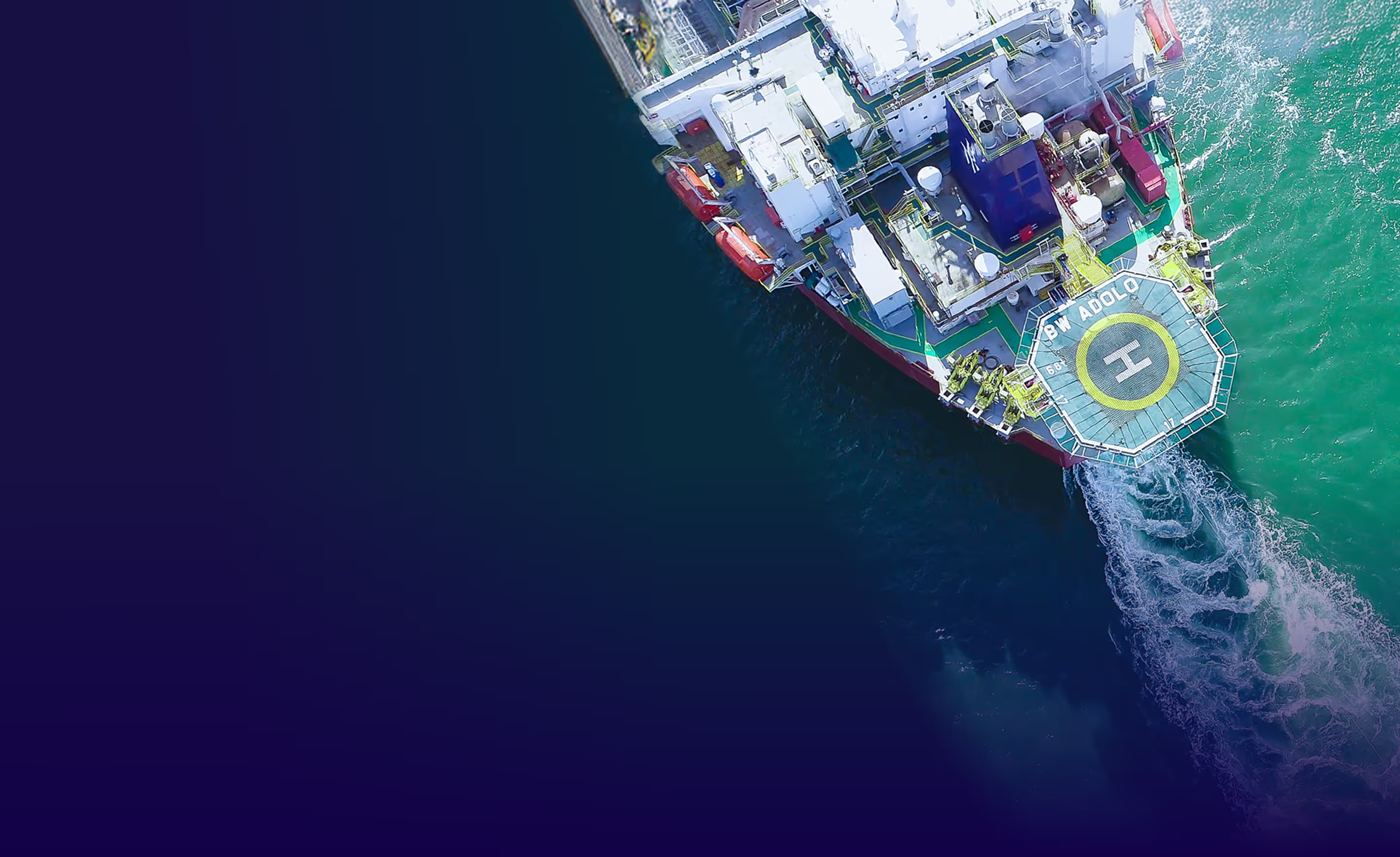
The landing area for helicopters facilitates transport of personnel and goods, and serves as a primary evacuation point.The helideck has facilities to enable refueling of helicopters as needed, and on some FPSOs, the helideck is large enough to allow space for two helicopters at the same time.
2
Flare Tower
The flare tower serves as a housing structure for flare tips. Flare tips are specially designed combustions equipment located on the tower’s top platform deck. The flare systems provides a safe and efficient means to destroy waste gases generated during both normal operations and emergencies.
The flare tower’s height is determined by the distance from the operating flare tip to point sources on the FPSO topsides. This ensures personnel exposure on the FPSO remains below allowable limits for acceptable heat radiation and noise.
4
Gas Compression & Treatment
When hydrocarbon gas is separated from well-fluids it is necessary to raise the pressure of the gas using mechanical compression to provide the required gas pressure for various purposes.
This can be for fueling power generators, or required for gas conditioning processes, or to reach higher pressures for purposes of delivering motive gas “gas-lift” to aid well-fluid production to the FPSO. Gas can also be reinjected back into producing reservoirs for pressure support or storage for possible later re-use.
Additionally, gas compressions and treatment is used to export treated gas to the required specifications for pipeline transfer to other facilities.
3
Gas Compression & Treatment
When hydrocarbon gas is separated from well-fluids it is necessary to raise the pressure of the gas using mechanical compression to provide the required gas pressure for various purposes.
This can be for fueling power generators, or required for gas conditioning processes, or to reach higher pressures for purposes of delivering motive gas “gas-lift” to aid well-fluid production to the FPSO. Gas can also be reinjected back into producing reservoirs for pressure support or storage for possible later re-use.
Additionally, gas compressions and treatment is used to export treated gas to the required specifications for pipeline transfer to other facilities.
The FPSO University is established to give a broader understanding of the operational techniques of petroleum processing, and the function and construction of the plant and equipment used in the processing of petroleum reservoir fluids on Floating, Production Storage and Offloading units, FPSOs.
20 e-learning modules are made available for self-study, and are available for non-BW Offshore employees.
The modules will enable you to select learning materials that suit your own particular requirements. Modules can be studied at your own pace and should be studied in the order set out. The study time needed will vary from one module to another, and from one individual to another – recommend between 1 - 6 hours for each module.
To get access to the FPSO University, simply click "Create new account" under the Login section.